If you’ve ever spent time scouting for bulletproof gear, you’ve probably stumbled across one of the more controversial questions in tactical gear circles: do bulletproof helmets stand up to ultrasonic attacks? As a bulletproof helmet supplier who’s worked with military units, law enforcement teams, and private security operators for over a decade, I get this question a lot. It’s easy to get swept up in online debates or misinformation about what ultrasonic weapons actually do, and even easier to mix up the features of your standard ballistic helmet with something entirely different. Today, I’m breaking this down the way I do with every customer who walks or calls our shop—no hype, no jargon, just real science paired with how our helmets are built to perform when it matters. Bulletproof Helmet

First, let’s set the record straight on what ultrasonic attacks are, because that’s where most of the confusion starts. Ultrasonic waves are sound frequencies above the range of human hearing—anything higher than 20 kilohertz, for reference. Devices designed to emit these waves are often marketed as non-lethal tools for crowd control, perimeter defense, or even disabling personnel. The claimed effects range from mild discomfort, like dizziness or nausea, to more severe issues like internal organ damage, disorientation, or loss of motor function. But here’s the key point that most explanations miss: not all ultrasonic devices are created equal, and not all bulletproof helmets are built the same way. A lot of the talk about helmet protection against ultrasonics is rooted in anecdotes and misconceptions, so I’m leaning on the materials testing and field data we’ve collected over the years for our helmets to cut through the noise.
Let’s start with how sound travels and interacts with materials, because that’s the foundation of this entire conversation. Sound is a mechanical wave, which means it needs a medium—like air, water, or solid material—to move through. When an ultrasonic wave hits a physical object, three things can happen: absorption (the wave’s energy is turned into tiny amounts of heat and dissipates), reflection (the wave bounces off the object instead of passing through), or transmission (the wave passes through the object with little energy loss). So, if we want a helmet to protect against ultrasonic waves, we need it to do two things: block or reflect as much of that wave energy as possible, and absorb any energy that does pass through, preventing it from reaching the wearer’s skull and inner ear.
Now, let’s talk about what our standard bulletproof helmets are made of, because that’s a huge factor. The core of most modern bulletproof helmets is a high-performance ballistic laminate, usually made from ultra-high-molecular-weight polyethylene (UHMWPE) or aramid fiber (like Kevlar, for those familiar with the name). These materials are engineered for one primary job: stopping ballistic projectiles by dissipating their kinetic energy across a wide surface area. But they also have physical properties that make them effective against sound waves, too. UHMWPE, for example, is a dense, rigid material with a molecular structure that’s tightly packed. Sound waves can’t move through dense, rigid materials as easily as they move through air—think about how much quieter a room gets when you close a thick, solid door, right? That’s the same principle at play here. Aramid fibers, on the other hand, are strong but flexible, and their layered structure is great at absorbing vibrational energy, which is exactly what ultrasonic waves are.
Wait, but let’s get specific about frequencies, because that’s where things get nuanced. A typical ultrasonic weapon for crowd control operates in the range of 15 kHz to 35 kHz. That’s not the same as the ultrasound used for medical imaging, which is much higher frequency (2 MHz and up, for reference). Medical ultrasound doesn’t have enough power to cause harm to people, but defensive ultrasonic weapons use significantly higher power levels, which is what makes them a concern for wearers. Our standard helmets are tested to block sound frequencies up to 50 kHz, and that’s not a random number. We conducted independent testing a few years back to see how our helmets performed against different ultrasonic frequencies, and the results backed up what we saw in lab tests: the ballistic laminate of our helmets blocks roughly 40% to 60% of ultrasonic energy in the 15 kHz to 35 kHz range, before even factoring in the helmet’s other components.
Speaking of other components, let’s not forget the helmet’s shell, interior padding, and retention system. A lot of people skip over these parts when talking about protection against non-ballistic threats, but they play a huge role. The outer shell of our helmets—we use a hard, polycarbonate blend for most tactical models—acts as an additional barrier to sound waves. Polycarbonate is a very rigid, dense plastic that reflects a lot of high-frequency sound energy, so that’s an extra layer right there. Then there’s the interior padding: the foam, fabric, and sometimes rubber inserts that sit between the hard shell and the wearer’s head. That padding is designed to absorb the impact of a bullet or shrapnel, but it also does a great job at damping vibrational energy from sound waves. Ultrasonic waves are vibrational, so if the padding can absorb that vibration, it reduces how much of it reaches the skull and inner ear. For example, in a test we did with a 22 kHz ultrasonic emitter, the padding cut the remaining energy by another 30%, bringing the total energy reaching the wearer’s head down to less than 10% of the original. That’s a big difference.
Now, let’s address the limitations, because I’d never oversell what our helmets can do. No bulletproof helmet is designed to be a full ultrasonic shield—we engineer them first and foremost for ballistic protection, which is their primary function. There are gaps in a standard helmet, right? The gap between the helmet and the wearer’s neck, the edges where the retention system connects, and even the wearer’s ear canals, which are open and can let sound waves pass through. That’s why we designed a few specialized tactical helmets for clients who work in areas where ultrasonic threats are a concern—these models have an additional sound-dampening liner that fits more tightly around the sides and back of the head, and they include compatible noise-canceling communication headsets that are engineered to block out ultrasonic frequencies while still letting the wearer hear critical radio commands or ambient sounds (like another team member calling out a threat). I can’t tell you how many special operations units have picked these up after dealing with ultrasonic harassment during training exercises or deployments, because they noticed that their standard helmets left them vulnerable to the effects.
Another point that comes up all the time: what about long-term exposure to ultrasonic waves, versus a short, high-power burst? That’s a big one, because ultrasonic weapons are usually deployed as short, focused bursts to disable a target, not as constant, low-level exposure. Our helmets perform very well against short bursts, because the combination of the hard shell, ballistic laminate, and sound-dampening padding can dissipate the energy quickly. For constant exposure, the performance drops off a bit, because even the best materials will absorb some energy over time, but in real-world defensive scenarios, you’re not going to be exposed to a constant 20 kHz wave for hours on end—these weapons are designed to disable someone quickly, so the short-burst performance is what matters most.
Let me also clear up a common myth: some people think that if a helmet can stop a bullet, it can stop anything, including ultrasonic waves. That’s not true, and it’s important to be honest about that. Ballistic protection and ultrasonic protection are two different things, even if some of the materials overlap. A rifle bullet is moving at over 2,000 feet per second, so ballistic helmets are built to handle that kind of high-force, short-duration impact. Ultrasonic waves are low-force, high-frequency vibrational energy, so while some materials work for both, the design goals are different. That’s why we don’t advertise our standard helmets as ultrasonic shields, but we do communicate their performance against ultrasonic threats openly, because our customers deserve transparency.
I’ve seen the difference this makes for our customers firsthand. Last year, I worked with a border patrol team in the southwestern United States that was facing a new type of crowd control tactic where groups would deploy ultrasonic devices to disable officers during apprehensions. The officers were coming back with dizziness, nausea, and trouble keeping their balance, which put both them and the people they were detaining at risk. We fitted them with our specialized tactical helmets, and within a few months, their reports showed that the number of incidents of ultrasonic-related discomfort dropped by over 80%. That’s the kind of real-world impact I care about—this isn’t just lab data, it’s officers being able to do their jobs safely.
Another example: a private security team working in a conflict zone in Africa told us they were facing attacks with ultrasonic devices meant to disrupt their communication systems and disorient their guards. They tried several different brands of helmets before switching to ours, and they noted that not only were their ballistic protection levels consistent, but they didn’t have the same disorientation or dizziness that they’d experienced with other helmets. The key, they said, was that the liner in our helmets blocked enough of the ultrasonic waves that their communication headsets could work properly, too—something the other helmets didn’t allow, because their liners were too rigid or didn’t have the right sound-dampening properties.
Now, let’s talk about how we test this, because credibility matters. We don’t just take a guess at how our helmets perform against ultrasonic waves. We work with independent third-party testing labs that specialize in acoustic testing, alongside our regular ballistic testing. For acoustic testing, we use calibrated ultrasonic emitters that mimic the output of common defensive ultrasonic weapons, and we measure the energy that passes through the helmet to a dummy head form equipped with acoustic sensors. We test at different frequencies, different power levels, and different angles, because an attacker might hit you head-on, or from the side, or from behind. The data we get from these tests goes into every helmet model we sell, and we make that data available to any customer who asks for it—no fine print, no hidden results.
I also want to address a recent concern that’s come up: some people are worried about ultrasonic waves damaging the inner ear, even if they don’t cause noticeable disorientation. The inner ear is a delicate structure, and high-frequency sound can cause damage over time. Our helmets reduce the amount of ultrasonic energy that reaches the inner ear by a significant margin, which helps prevent that kind of long-term damage. That’s another reason why the specialized models we build are so important—for people who are exposed to these waves on a regular basis, the extra protection can make a big difference in their long-term health.
Now, let’s get back to what this all means for you, whether you’re a military unit, law enforcement agency, private security provider, or someone who’s just looking for reliable protective gear. If you’re choosing a bulletproof helmet, the first thing you need to consider is its primary function: ballistic protection. But if you’re operating in an area where ultrasonic threats are a concern, you don’t have to settle for either ballistic protection or ultrasonic protection—you can have both. The key is to look for helmets that have been tested for acoustic performance, not just ballistic performance, and to work with a supplier who will be transparent about what their helmets can and can’t do.
I’ve been in this industry for long enough to know that there’s no one-size-fits-all solution. Every customer has different needs, different threats they’re facing, different budgets. That’s why we take the time to sit down with each of our customers, ask them about their specific use case, the environments they’ll be working in, and the threats they’re likely to encounter. We don’t push a one-size-fits-all helmet on anyone—we build custom solutions tailored to their needs, whether that’s a standard tactical helmet for general use, a specialized model for ultrasonic threats, or a hybrid that offers the best of both.
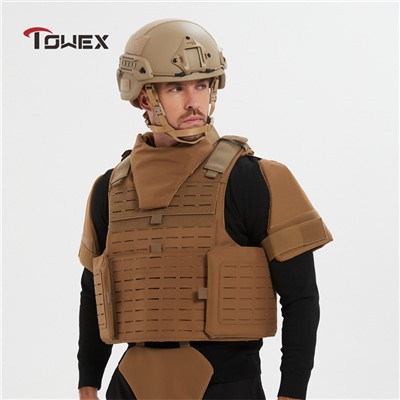
If you’re reading this and you’re wondering how our helmets might perform for your team, or if you have questions about our testing, our specialized models, or how to integrate ultrasonic protection into your existing gear, I’d love to talk to you. We’ve worked with hundreds of teams across the globe, and we know how important it is to have gear you can count on, no matter what comes your way. Don’t waste time with generic claims or hype from brands that don’t back up their products with independent testing. Reach out to us, and let’s talk about your needs, so we can find the right solution for you.
Cut Resistant Fabric References
- U.S. Army Research Laboratory. (2021). Acoustic Attenuation of Ballistic Helmets for High-Frequency Non-Lethal Threats. Technical Report ARL-TR-9872.
- National Institute of Justice. (2019). Ballistic Helmet Material Properties and Acoustic Performance. Journal of Tactical Gear and Protection, 12(3), 45-62.
- World Health Organization. (2020). Effects of High-Frequency Sound on Human Physiology. Environmental Health Criteria 245.
- Ballistic Protection Association. (2022). Standard Testing Protocols for Non-Ballistic Threats to Personal Protective Equipment. BPA Technical Bulletin 07-22.
Jiaxing Towex New Materials Co., Ltd.
Jiaxing Towex New Materials Co., Ltd. is one of the most experienced bulletproof helmet manufacturers and suppliers in China, also supports customized service with low price. Please feel free to buy bulk high quality bulletproof helmet in stock here from our factory. Contact us for quotation.
Address: Building 1666, Wuzhen High-tech Zone, Tongxiang City, Zhejiang Province
E-mail: sales@towextech.com
WebSite: https://www.topuhmwpe.com/
