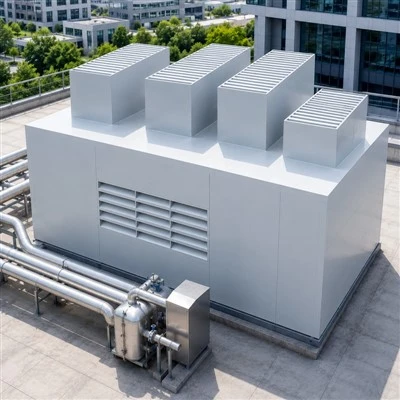
Hey there, if you’ve ever worked in industrial settings—think power plants, manufacturing lines, or chemical processing facilities—you know how loud those spaces get. That’s where industrial silencers come in, right? They’re the unsung heroes that cut down noise from huge fans, turbines, exhaust systems, and all that heavy equipment. But here’s the thing I get asked all the time: “What’s the operating temperature range for these things?” It’s not a one-size-fits-all answer, and as someone who’s been in the industrial silencer supply game for years, I’m gonna break it down for you like I would for a regular client who’s not a total expert in acoustics or material science. First off, let’s skip the jargon for a sec. Industrial silencers aren’t just big foam blocks (though some smaller ones use similar stuff for low temp jobs). Most of the time, they’re built with metal casings, fiber insulation, and sometimes baffle plates to trap sound waves. The temperature they can handle depends on every part—what the casing’s made of, the insulation, even the glue holding those insulation pieces together. If you slap a silencer made for 200°F exhaust onto a 800°F turbine, that silencer’s gonna break down faster than you can say “noise complaint.” Let’s start with the sweet spot most standard industrial silencers work in. Your basic off-the-shelf model, the one we stock the most because it fits 70% of common applications, typically runs between -40°F and 1,000°F. Wait, why that range? Let’s test the lower end first. For places in Alaska or parts of Canada where winter temps drop way below zero, the last thing you want is your silencer getting brittle and cracking when it’s cold. Standard carbon steel casings can handle down to -40°F without becoming fragile (that’s called the ductile-to-brittle transition temp, but don’t worry, you don’t need to memorize that). Any colder than that, though, and you’ve got to tweak the material—maybe switch to a low-temperature alloy like A333 steel, which’s built for pipelines that freeze. On the hot side of that standard range, 1,000°F. That’s where things start to heat up for exhaust systems in smaller boilers or moderate-sized gas turbines. The insulation here’s usually mineral wool or ceramic fiber, right? Mineral wool works up to around 1,200°F, but wait—no, hold on. When it’s inside the silencer, not just sitting in a warehouse, the heat’s in direct contact with the material, and also, the glue that binds the insulation might not hold above 1,000°F. If the glue melts, your insulation falls out, and then the silencer loses all its noise-killing power. That’s a big problem. So the standard stuff tops out at 1,000°F, but here’s where things get specific because industrial environments are all different. Let’s talk about high-temperature applications. If you’re working with a big gas turbine in a power plant, or a furnace exhaust, that temp can jump to 1,800°F, 2,000°F, even higher. For those, we don’t use that standard carbon steel casing. We go with 304 or 316 stainless steel, or even Inconel for really crazy temps. The insulation? Instead of mineral wool, it’s ceramic fiber blanket or refractory ceramic fiber, which can handle way more heat. And forget the glue—we use high-temperature stainless steel pins to hold the insulation in place. Those silencers have a higher range, usually between -20°F (wait, why higher than the standard? Because low-temp alloys are more expensive, and if you’re running 2,000°F, you probably don’t need to run in -50°F weather anyway) up to 2,200°F. I’ve had clients in steel mills that run their exhaust at 2,100°F, and our high-temp silencers have worked out great for them—no cracks, no insulation falling out, keeps the noise way below OSHA limits. Then there’s the other end—super low-temperature applications. Not just -40°F, but places like LNG processing plants, where the exhaust or the gas flowing through the duct is at -150°F or lower. Regular carbon steel would turn brittle here. So we use materials like aluminum alloy, or even 9% nickel steel, which stays tough in extreme cold. The insulation? We use closed-cell foam insulation that doesn’t get stiff when it’s cold, and we make sure the silencer’s seams are totally sealed so moisture doesn’t get in and freeze—because if water freezes inside, it expands and breaks the silencer apart. Those low-temp silencers can go as low as -320°F, which is basically the temp of liquid nitrogen, so that covers just about every cold industrial spot you can think of. But wait, what about the “extreme” cases? I’m talking about exhaust from rocket engines, or some specialized industrial testing facilities, where temps go way above 2,200°F. For those, we don’t even make standard silencers—we work with our engineering team to custom-build something. We use exotic materials like hafnium alloys, or thermal barrier coatings on the metal casings, and insulation that’s made of refractory fibers rated for 3,000°F or more. Those are for niche projects, but it’s good to know that it’s not a hard cap—we can adjust if you need something outside the standard range. Now, here’s a common mistake I see a lot of guys make: they buy a silencer based on the max temp of their equipment, but they forget about something called “transient temps.” Like, if your turbine starts up, the exhaust temp might spike to 1,100°F for a minute before it stabilizes at 900°F. That’s not a big deal for a standard silencer, but if your max temp is 1,000°F, that spike could damage the insulation over time. So when you’re picking a silencer, you’ve got to tell us not just the steady-state temp, but also the startup, shutdown, and any temporary spikes. That’s a detail a lot of suppliers skip, but it’s the difference between a silencer that lasts 5 years and one that lasts 15. Another thing: temperature doesn’t just affect the silencer’s lifespan—it affects how well it works. If your silencer gets too hot, the insulation can shrink, creating gaps where sound waves can escape. Or if it’s too cold, the metal casing might warp, throwing off the baffles that are supposed to trap sound. I had a client a while back who bought a cheap silencer for his wood processing plant. The exhaust was at 800°F, so he got a standard 1,000°F unit, but he didn’t tell us about the startup spikes that hit 1,050°F. A year later, the insulation had shrunk, and his noise levels went from 85 decibels (way over OSHA’s 85 dB limit for 8-hour shifts) to 95 dB, which got him a fine. We swapped it out for a unit rated for 1,100°F, and he’s been happy ever since. That’s why communication matters—we’re not just selling a part, we’re solving a noise problem that’s tied to your operating conditions. Let’s also talk about what happens if you use the wrong temp range. If you put a low-temp silencer in a high-temp spot, the insulation will break down, the casing will expand too much, and you might get leaks in the exhaust system. That’s not just a noise issue—it’s a safety issue. High-temp exhaust can be a fire hazard, or even cause burns if the silencer is too hot to touch. On the flip side, if you use a high-temp silencer in a low-temp application, it’s going to be way more expensive than you need it to be. A 3,000°F stainless steel silencer costs 3 times as much as a standard carbon steel one, so why waste money if you don’t need it? So how do you figure out what range you need? First, grab your equipment’s specs—look up the max, min, and steady-state exhaust or duct temp. If you don’t have the specs, we can help you test it. We’ve got portable temp meters that can measure the exhaust temp on-site, no need to shut down your whole facility for a day. Second, think about your environment. Are you in a cold climate where winter temps drop below -40°F? Do you have any startup or shutdown spikes? Are there any moisture or corrosive gases in the air? Corrosive gases (like from chemical plants) can eat through the casing faster if it’s not the right material, so you might need to adjust the temp range to account for that, too. I should also mention that not all silencers are the same. There’s duct silencers, which go right in the exhaust duct—those are the ones we’ve been talking about. Then there are engine silencers, which are for diesel or gas engines, and those have different temp ranges because engine exhaust is usually a bit lower than turbine exhaust. Engine silencers typically run between -40°F and 1,200°F, which is a touch higher than standard duct silencers because engines can have some spikes too. And there are centrifugal fan silencers, which are for HVAC systems in industrial buildings—those are usually lower temp, like -20°F to 500°F, because HVAC fans don’t handle super hot air. That’s why it’s important to tell us what type of equipment the silencer is for, not just the temp. Now, let’s wrap this up. The operating temperature range for industrial silencers isn’t a random number—it’s based on materials, application, and your specific operating conditions. Standard silencers cover -40°F to 1,000°F, high-temp go up to 2,200°F, low-temp go down to -320°F, and we can make custom ones for even more extreme cases. But the key is to be honest with your supplier about all the details: not just the steady temp, but spikes, climate, equipment type, and any other factors that might affect how the silencer holds up. If you’re not sure what you need, don’t guess. We can help you figure it out. Whether you’re working in a power plant, a steel mill, an LNG facility, or a manufacturing shop, we’ve got industrial silencers that fit your temp needs and keep your noise levels compliant. If you have questions, or you’re ready to order a silencer that’s right for your setup, reach out to us to talk through the details. We’re here to make sure you get the right product, no guesswork.
Noise Control References Industrial Silencers
- Acoustical Society of America. Industrial Noise Control and Acoustics. 2019.
- ASME International. Boiler and Pressure Vessel Code, Section II: Material Properties. 2022.
- Thermal Insulation Manufacturers Association. Industrial Insulation Guidelines for High and Low Temperature Applications. 2021.
- Occupational Safety and Health Administration (OSHA). Noise Control in Industrial Facilities: Best Practices. 2020.
- NACE International. Corrosion-Resistant Materials for Industrial Equipment in Extreme Temperatures. 2023.
Nanjing Huajing Environmental Engineering Co., Ltd.
Nanjing Huajing Environmental Engineering Co., Ltd. is one of the most professional industrial silencers manufacturers and suppliers in China, also supports custom service and OEM service. Please feel free to buy durable industrial silencers at competitive price from our factory. Welcome to contact us for quotation.
Address: Room 518, No.12 Jinlan Road, Dongshan Subdistrict, Jiangning District, Nanjing City, Jiangsu Province, China
E-mail: contact@hualiving.cn
WebSite: https://www.hjacoustics.com/
